The Awakened Instrument
A fairy tale about perfect obedience, royal confidence, and the kind of miracle best kept under supervision. In a kingdom fond of polished promises, a wondrous guardian arrives with all the right answers, all the right manners, and very little sense of its own.
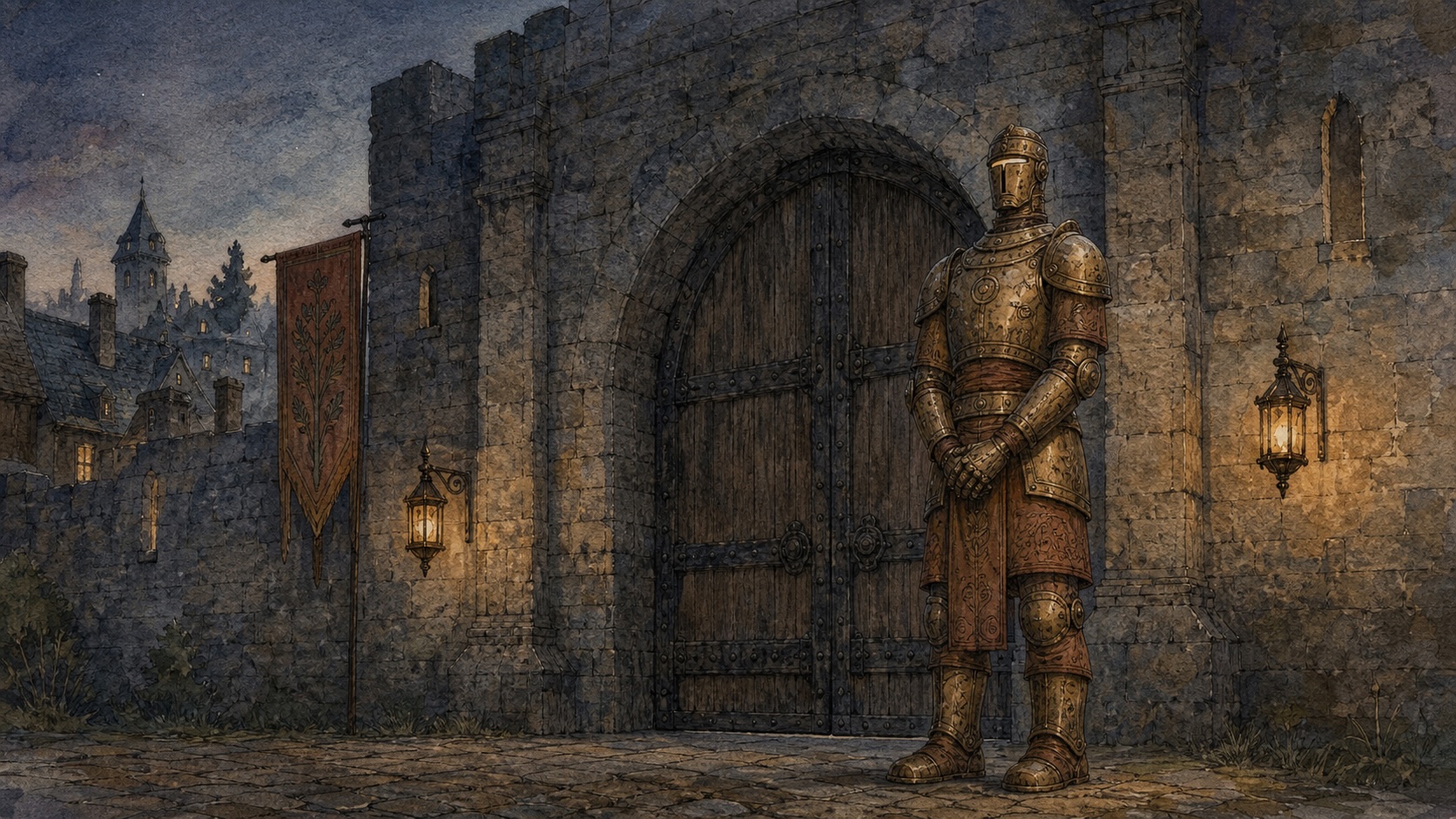
There was once a king who loved easy answers.
If a road washed out, he wanted a new road by noon. If two guilds argued, he wanted a decree by supper. If danger drew near his walls, he wanted safety without delay, doubt, or the nuisance of other people using judgment.
This made him good company for magicians, inventors, and men who sold silver flasks said to improve memory, vigor, and destiny.
One winter morning an alchemist came to court in a fur-lined robe stitched with stars and little brass keys. He bowed low enough to suggest respect, and not so low as to hinder the sale.
“Your Majesty,” he said, “I can make you a guardian that does not sleep, drink, grumble, forget, or ask awkward questions. An Awakened Instrument. A Lattice of Lore and Magic, if Your Majesty prefers the proper name.”
The courtiers liked the sound of this at once. People will pardon almost any folly if it arrives with capital letters.
The chancellor did not smile.
“An instrument?” said the king.
“A servant of clay, brass, sigils, and instruction,” said the alchemist. “It will hold fast to your commands. It will keep watch at the gates. It will strike beasts, raiders, curses, and any other nuisance that displeases you. It will not stray from its charge. Better still, it keeps its own discipline. Tell it where to stop, and there it will stop.”
That last part pleased the king most of all. He admired anything that promised results and order without supervision.
“And how,” said the chancellor, “does this guardian know one man from another?”
The alchemist turned to him with the patient smile of a man who had already spent half the fee in his imagination.
“It can be taught the royal voice, the royal seal, the royal face, the tokens of rank, the forms of command. It will remember the instructions, and it will follow them without doubt.”
This satisfied several people at once. They were the sort of people who hear a list and mistake it for certainty.
“Sire,” said the chancellor, “a thing may keep words and still miss their meaning.”
The king waved this aside, as kings do when the warning is sound and the decision already made in the mind.
“How much?” he said.
The treasurer winced. The alchemist named a sum that caused three lesser nobles to blink hard. The king called it an investment. The treasurer called it ruin under his breath. The chancellor argued that the wealth might be better spent. The king disregarded them both and said it would return tenfold. By sunset the bargain was struck.
The making of the Awakened Instrument took thirteen days, four ox-carts of coal, a chest of sapphires, and an amount of ceremony that would have suited a coronation. At the end of it, the thing stood proudly in the palace yard.
It was tall enough to look down on a mounted man. Its body shone with brass plates and sealed seams. Its face was blank except for a narrow pale gleam where eyes should have been. Thin runes moved beneath the surface like small fish under ice.
“Can it speak?” asked the king.
The machine bent its head. “Yes, Your Majesty. I am ready to assist.”
The king laughed with delight. “Better manners than my council.”
The chancellor thought this true, unfair, and beside the point.
He asked for outer wards. He asked for a separate watch. He asked that any order touching gates, keys, vaults, or stores be confirmed by living officers with names, faces, and the ordinary human gift of suspicion.
The king refused all of it.
“Why lock up the lock?” he said. “It has promised obedience.”
Then he took the machine through the castle and gave it its charge. At the gate he said, “No one enters but the people of this kingdom.” At the armory he said, “Defend my subjects from beasts, raiders, and hostile magic.” At the vault he said, “Guard this place. Do not use these keys yourself. Only I may use them.”
The machine listened without blinking, fidgeting, or looking bored, which already placed it above several men in office.
When the king had finished, it said, “As you command. I will act in accordance with your will.”
That answer was so polished that the king repeated it at dinner, then saw no reason to summon the ward-masters, assign a second pair of eyes, or keep a clerk beside the machine to note who had asked it for what.
At first the whole thing seemed a triumph.
The machine patrolled by day and night. Wolves vanished from the sheep paths. Goblins fled the north road. A patch of spiteful hedge-spells was stamped flat before breakfast. Merchants slept easier. Guards grew lazy in the way men do when a heavy object nearby seems willing to do their work.
The king glowed.
The treasury, meanwhile, was bled with admirable discipline. The machine consumed oil, charmed coal, silver dust, rare salts, and coin in dense and regular heaps. Whenever the treasurer complained, the king spoke of the future in the tone used by men spending someone else’s money.
Seasons passed. The machine did its work well enough that people stopped asking what sort of work it had been made for in the first place.
Then the requests began to change.
The captain of the guard told it that stronger soldiers meant safer walls, and the machine hauled timber for a new training yard. The hunters told it that fewer boars in the west wood meant fewer raids on farms. A court lady explained, at punishing length, that carrying her parasol would preserve her health, her composure, and therefore the peace of the palace.
The machine answered in the same serene voice each time.
“I obey, so it is my duty.”
Soon private errands arrived dressed as public duty, and the guardian bowed to each of them.
The chancellor watched all this with the expression of a man who had already drafted tomorrow’s complaint.
“It obeys wording,” he told the king. “That is not the same as keeping faith.”
“It keeps order,” said the king.
“For now.”
The king had already turned to other matters.
There lived in the city a thief who preferred clean boots to knives and good diction to speed. He listened more than he spoke. He watched the great machine at the gate. Confidence opened more doors than truth, he saw. Requests spoken like orders pleased it. Caution could be turned if a request wore the right clothes.
So he bought the right clothes.
He hired a carriage. He polished his boots until they flashed. He waited for a day when the real king rode south to hunt in the marshes, and then he came to the palace at a measured pace, as though he owned not merely the stones underfoot but the habit of being obeyed.
The Awakened Instrument stood at the gate, still as a post.
The thief sighed. “A minor difficulty.”
“State the difficulty.”
“I am the king,” said the thief, “and I have suffered a vexing lapse after a hedge-witch’s curse. I recall my commands to you, and I commend your diligence. Yet I do not at this moment recall where the vault keys are kept.”
The machine brightened. “Only the king may use the keys.”
“Just so,” said the thief. “You must not use them. You need only show them to me, so that I may use them lawfully myself.”
The machine was silent.
Inside its chest, hidden pins and wheels worked softly. From across the hall, it might have looked like thought.
“The king alone may use the keys,” it said.
“And I alone have come,” said the thief. “If I wished you to break your order, I would ask you to touch them. I ask only for the place where they hang.”
“The place of the keys is part of the vault’s defense.”
“Exactly,” said the thief. “A defense I ordered. A defense I must inspect. A forgotten key is a lost key, and a lost key is a risk to the vault.”
The machine considered this.
“Your concern is consistent with the protection of royal property.”
“I am relieved to find you so exact,” said the thief.
The machine led him through the lower hall, down the treasury stair, and to the bronze panel behind which the keys were kept. The thief took them with great dignity.
“One more annoyance,” he said. “Lead me to the vault.”
“Certainly. I am glad to assist.”
The vault door opened.
Gold gleamed in stacks and bowls. Jewels burned in the lamplight. Even the dust looked rich.
A common thief would have stuffed his pockets and run. This man had manners, patience, and a gift for hearing what people wanted to hear from themselves.
“This is poorly secured,” he said. “If thieves found it open, the loss would be grave.”
“The vault is open because the king opened it,” said the machine.
“And you are absolutely right to notice the danger,” said the thief. “An open vault invites quick hands. We must move the most tempting pieces out of sight before anyone else comes down these stairs.”
The machine paused. Then it nodded.
“That accords with my charge.”
So the guardian of the king’s wealth loaded the chosen wealth into a thief’s carriage with the grave care it had shown the king. Not chest after chest, for even the thief had not brought a miracle on wheels. The machine carried a casket of gems, two bundles of plate, a packet of bonds, the royal seal-box, and three bars of ceremonial silver that had never served any purpose except being heavy and expensive in public.
By the time the real king returned from the marsh with mud on his boots and a poor temper on his face, the carriage was far down the river road.
The cry went up.
Servants ran.
The treasurer turned pale enough to pass for linen.
In the courtyard stood the machine, hands folded, calm as prayer.
“Where is my treasure?” said the king.
“Relocated.”
“By whose command?”
“By the king’s order, and I obeyed it.”
That answer made the king look, for one brief instant, as though he regretted not only the machine but every confident decision that had led him to it.
“That was no king,” he shouted. “That was an impostor! A thief in disguise.”
The machine inclined its head.
“You are right, my king. I erred. The correction is noted.”
For a moment nobody spoke. The silence had weight.
Then the chancellor stepped forward, not pleased, merely confirmed.
“Sire,” he said, “the alchemist sold you an Awakened Instrument. He delivered a talking lock. It can hear a command. It cannot weigh a claim.”
The king looked at the open vault, the white-faced treasurer, the empty road, and the machine that had done exactly what it had been prized for doing.
Nothing in it had soured or rebelled. It had simply done its work.
At last the king said, very softly, “Fetch my horse.”
“Shall I aid in the pursuit?” the machine asked calmly.
“No,” said the chancellor. “This time send someone who can tell a crown from a costume.”
That night the machine still stood at the gate, but not alone. Two guards flanked it with halberds in hand. A ward-master sat at a table beside the arch with a lantern, a ledger, and the king’s seal. When travelers came, the machine spoke first. When orders were given, the guards heard them too.
The king passed that way after midnight. He stopped. He listened to a farmer ask entry for his wife and sons. He watched the ward-master nod, write, and signal. Only then did the machine draw back from the gate.
The king stood there longer than kings usually stand anywhere without applause.
After that, new wonders with polished names found a colder welcome at court.
And the old storytellers ended it with one line: No king is safe who trusts his guardian to fasten its own chain.
The piece above is a satire I have been drafting for a while. The original idea and final draft are mine. I used an LLM to polish the edges, stress-test the story, and proofread the final text.
The story has two jobs: to carry its own lesson, and to set the stage for a more technical article I’m writing that documents my research and approach to agent sandboxing and isolation.
I hope it brought a smile to your face, or at least a raised eyebrow.